


The decision to add a swimming pool to your property in Van Alstyne is often born out of a specific kind of necessity. By the time mid-July arrives in Grayson County, the heat doesn’t just settle; it radiates from the blackland prairie soil, making traditional outdoor activities nearly impossible. While many homeowners initially view an above-ground unit as a simple alternative to the complexities of excavation, the reality is that a high-quality above-ground Pool Installation in North Texas requires a rigorous understanding of engineering, soil science, and local hydrology.
In this region, the ground is not a static platform. It is a living, breathing geological entity. For a pool to survive the transition from 2025 into 2026 and beyond, it must be installed with an authoritative grasp of the environmental stressors unique to the Van Alstyne landscape. At DSH Homes and Pools, we believe that the difference between a pool that lasts five years and one that lasts twenty lies in the invisible work performed before the first gallon of water is ever added.
1. The Geological Reality: Navigating the Grayson County Clay
To understand the mechanics of a professional above-ground Pool Installation, one must first understand the chemistry of the earth beneath it. Van Alstyne sits atop high-plasticity clay, often referred to as “expansive soil.” This material undergoes radical volumetric changes based on its moisture content.
The Physics of Soil Heave
When clay is saturated during our intense spring thunderstorms, it expands with enough force to lift concrete slabs and twist metal frames. Conversely, during a North Texas drought, the soil shrinks, creating deep fissures and “voids.” If your pool is sitting directly on this clay without a structural buffer, the shifting weight of 15,000 to 20,000 gallons of water—roughly 125,000 to 160,000 pounds—can lead to localized settling. Even a one-inch difference in level across a 24-foot diameter can compromise the structural integrity of the pool wall.
The Stabilization Process
A professional installation begins with the mechanical removal of all organic matter and a deep-cut excavation to reach a stable sub-grade. In Van Alstyne, we often utilize a “crushed stone” or “granulated sand” base that is mechanically compacted in lifts. This creates a non-expansive “pad” that allows the pool to sit independently of the clay’s seasonal movement. This layer doesn’t just provide levelness; it provides drainage, ensuring that water doesn’t pool against the bottom rail of your structure, which is the leading cause of premature corrosion.
2. Hydraulic Design and Site Drainage
In the Texas landscape, water is both the goal and the primary enemy. A significant portion of a above-ground Pool Installation is dedicated to managing “runoff.”
Diversionary Grading
Most properties in our area feature subtle slopes designed to move water away from the home’s foundation. When you place a 20-foot or 30-foot circle in the middle of that yard, you are essentially creating a dam. Without proper “swales” or a “French drain” system integrated into the site plan, rainwater will build up on the uphill side of the pool. Over time, this hydraulic pressure can wash out the sand base beneath your liner, leading to “heel divots” or, in extreme cases, a total wall collapse.
Calculating the Water Table
While Grayson County isn’t a swamp, localized high water tables can occur after heavy rainfall. Professional installers must assess the “hydrostatic pressure” potential of the site. If water builds up under the pool liner, it can cause the liner to “float” or create “bubbles” of water between the vinyl and the floor. Our technical approach involves ensuring the installation site is the highest point in the immediate vicinity or is protected by a dedicated drainage curtain.
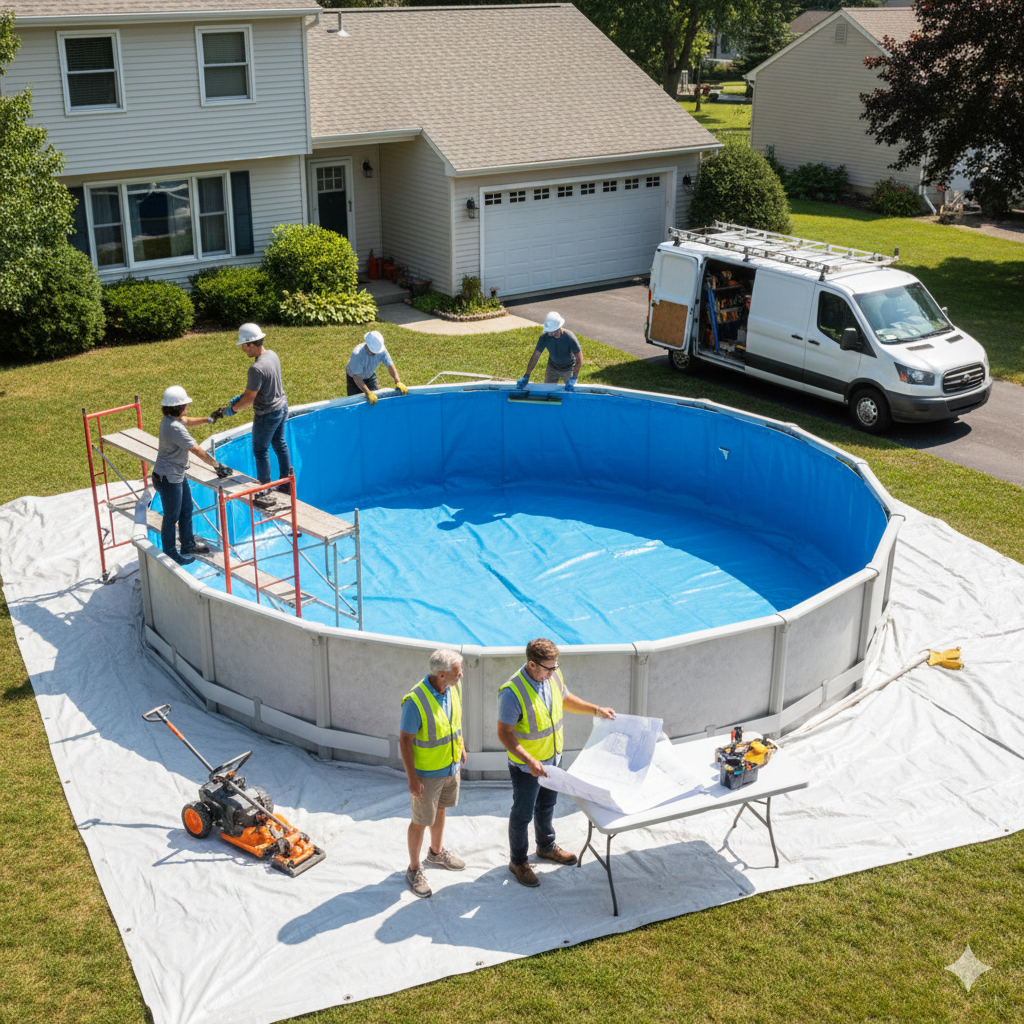
3. Structural Anatomy: Selecting Materials for the Texas Sun
The North Texas sun is a relentless source of UV radiation. Materials that survive in the Midwest often fail within a few seasons in Van Alstyne. When selecting a system for above-ground Pool Installation, the choice between steel, resin, and hybrid models is a matter of longevity.
The Resin Revolution
In 2026, resin has become the gold standard for high-end above-ground builds. Resin components (top rails, uprights, and bottom plates) do not rust, but more importantly, they do not retain heat. On a 105°F day, a steel top rail can become hot enough to cause discomfort; resin remains cool to the touch. Furthermore, resin is impervious to the “salt-air” corrosion that can occur if you choose to utilize a salt-water chlorine generator.
Wall Coatings and Protection
The corrugated steel wall of the pool is its “spine.” We look for walls that feature a multi-stage coating process:
- Galvanization: A zinc coating to prevent oxidation.
- Primer: For adhesion.
- Liquid Plastic (Plastisol) or Krystal Kote: A thick UV-resistant layer that protects the metal from the chemicals inside and the elements outside.
4. The Engineering of Levelness: More Than a Spirit Level
One of the most common failures in amateur above-ground Pool Installation is an reliance on basic tools for a complex job. A pool must be level within 1/8th of an inch across its entire diameter.
Transit and Laser Leveling
At DSH Homes and Pools, we utilize optical transits or rotary laser levels to establish the “grade.” Because the weight of the water is so immense, any slight lean creates “eccentric loading” on the pool wall. If the water is two inches higher on one side than the other, the pressure on the “low” side is significantly greater. In high-wind events—which are common in the open plains of Van Alstyne—this imbalance can cause the pool to “buckle.”
The “Patio Block” Foundation
Every upright post of an above-ground pool must sit on a solid, non-compressible foundation. We utilize heavy-duty 2-inch thick concrete patio blocks buried flush with the compacted sub-base. This prevents the “legs” of the pool from sinking into the ground over time, ensuring the wall remains perfectly vertical and the tension is distributed evenly across the bottom track.
5. Electrical Safety and Bonding in 2026
Water and electricity are a lethal combination, and the safety codes surrounding pool installations have become increasingly stringent. A professional above-ground Pool Installation must adhere to the National Electrical Code (NEC).
The Bonding Loop
One of the most misunderstood aspects of pool safety is “bonding.” This is not the same as grounding. Bonding involves connecting all metal parts of the pool (the wall, the pump motor, and even the water itself via a bonding plate) with a #8 solid copper wire. This creates an “equipotential plane,” ensuring that if a short circuit occurs, there is no voltage differential between the water and the metal components. This prevents “stray voltage” shocks, which are a serious risk in residential environments.
GFCI Protection
All pool equipment in Van Alstyne must be protected by a Ground Fault Circuit Interrupter (GFCI). Given our local tendency for lightning and power surges during “dry line” storms, we advocate for the installation of dedicated surge protectors at the equipment pad to protect expensive variable-speed pumps and salt cells.
6. Filtration and Hydraulics: Keeping the Oasis Pristine
A pool is only as good as its circulatory system. In the high-heat environment of Van Alstyne, water can turn from “crystal clear” to “algae green” in less than 48 hours if the hydraulics are insufficient.
Variable Speed Pumps (VSP)
In the past, above-ground pools were often paired with small, inefficient “thimble” pumps. In 2026, we emphasize the use of Variable Speed Pumps. These allow the homeowner to run the pool at a very low speed for 24 hours a day, providing constant filtration and chemical distribution for a fraction of the cost of running a single-speed pump for 8 hours.
Selecting the Filter Media
- Sand Filters: Reliable and easy to use, but only filter down to 20-40 microns. In the dusty environment of North Texas, sand filters often struggle with “fine” particulate matter.
- Cartridge Filters: The preferred choice for Van Alstyne. They filter down to 10-15 microns and do not require “backwashing,” which saves thousands of gallons of water—a vital consideration during local water restrictions.
7. Liner Integrity and the “Perfect Fit”
The liner is the only thing keeping the water inside the pool. In the above-ground Pool Installation process, “liner pull” is a technical art.
Managing Temperature for Vinyl
Vinyl liners have a “memory.” If a liner is installed on a cold day, it will be brittle and prone to tearing. If it is installed on a 100-degree day, it can become too “stretchy,” leading to wrinkles that become traps for debris and algae. A professional installer monitors the ambient temperature and the “internal” temperature of the pool shell to ensure the vinyl is seated with the perfect amount of tension.
The Cove and the Base
The “cove” is the transition between the pool wall and the floor. We utilize pre-formed high-density foam coves rather than the traditional “sand cove.” Foam coves cannot wash away, and they provide a consistent, cushioned transition that prevents the liner from being pinched or over-stretched at the base of the wall.
8. Safety and Local Compliance in Van Alstyne
The City of Van Alstyne and Grayson County have specific ordinances regarding residential pools. Ignorance of these codes can lead to fines, insurance cancellations, or, worse, safety hazards.
The Barrier Code
Texas law is very specific: any pool with a depth of 24 inches or more must be protected by a barrier that is at least 48 inches high. For an above-ground Pool Installation, this often means:
- An “A-Frame” ladder with a lockable outer staircase.
- A “Fence-on-Pool” system that extends the height of the pool wall.
- Self-closing and self-latching gates.
Setbacks and Easements
Your property likely has utility easements for electric, gas, or fiber-optic lines. We perform a thorough site assessment to ensure your pool is not encroaching on these zones. Furthermore, most local zoning requires a “setback” (usually 5 to 10 feet) from the property line and the primary residence to allow for emergency access and to prevent drainage issues for neighbors.
9. Longevity and The “Staycation” Investment
While an above-ground pool is often seen as a more affordable option than an in-ground build, the lifestyle return on investment (ROI) is identical. In a community like Van Alstyne, where “neighborly connection” is a core value, a professionally installed pool becomes the hub of the home.
Equity and Resale
A poorly installed pool is a liability when it comes time to sell your home. A professionally installed above-ground Pool Installation, complete with a custom deck and integrated landscaping, adds “curb appeal” and functional value. It shows prospective buyers that the home has been meticulously maintained and is ready for the Texas summer.
The Maintenance Mindset
As we look toward the future, automation is making pool ownership easier. We can now integrate smartphone-controlled lighting, chemical monitoring, and automated cleaners. This ensures that the “work” of owning a pool is minimized, allowing you to spend your time enjoying the water rather than scrubbing it.
10. Frequently Asked Questions (FAQ) for Van Alstyne Homeowners
Q: Can I install an above-ground pool on a slope? A: Yes, but the ground must be excavated to level, never “built up.” If you add dirt to a low spot to make it level, the weight of the water will eventually compress that “fill” dirt, causing the pool to lean. We always dig down to the lowest point.
Q: How long does a professional installation take? A: For a standard 24-foot round pool, the actual assembly takes 1 to 2 days. However, the site preparation, electrical work, and permitting often take 2 to 3 weeks.
Q: Is salt water better for above-ground pools? A: Salt water is gentler on the skin and hair, but it is highly corrosive to steel. If you want a salt system, we strictly recommend a full resin pool model to ensure the salt does not eat through the wall or the frame.
Conclusion: Crafting Your Private Oasis
An above-ground Pool Installation is more than a purchase; it is a modification of your home’s ecosystem. In the challenging environment of Van Alstyne, TX, success is measured in the stability of the foundation, the safety of the electrical bonding, and the efficiency of the filtration.
At DSH Homes and Pools, we don’t just “set up” pools. We engineer backyard retreats. We understand that your backyard is where your family’s memories are made, and we take the responsibility of building that stage with the technical precision it deserves. Whether you are battling the Grayson County clay or looking for the perfect resin hybrid to withstand the Texas sun, we are here to ensure your vision becomes a shimmering, long-lasting reality.