


For the discerning homeowner in Van Alstyne, the decision to invest in a backyard transformation is rarely impulsive. It is a calculated move to enhance property value, combat the relentless North Texas heat, and create a private sanctuary for family connection. However, the path to a shimmering aquatic retreat is paved with complex engineering decisions, geological challenges, and precise regulatory requirements. As we move into 2026, the standards for In-Ground Pool Installation have evolved far beyond simple excavation and concrete.
At DSH Homes and Pools, we recognize that a pool is a monolithic structure that must coexist with some of the most challenging soil conditions in the United States. In the expansive clay prairies of Grayson County, a pool is not just “built”—it is engineered. This article serves as an authoritative resource for homeowners, detailing the technical imperatives and localized strategies necessary for a successful, lifelong pool installation.
1. The Geological Challenge: Navigating Van Alstyne’s Expansive Clay
The single most significant obstacle to a successful In-Ground Pool Installation in Van Alstyne is the soil. Our region is defined by high-plasticity clay that undergoes extreme volumetric changes based on moisture content. When it rains, the clay swells with immense hydraulic force; during a dry Texas summer, it shrinks and cracks.
Managing Structural Load
Without advanced engineering, this “heave and shrink” cycle can snap a concrete pool shell like a dry twig. To counter this, professional installation requires a robust structural design. We utilize a dense grid of Grade 60 rebar, often spaced much closer than standard building codes require. This creates a steel skeleton that allows the pool to act as a single, rigid unit, resisting the lateral pressure exerted by the moving earth.
Hydrostatic Pressure Relief
In areas of Van Alstyne with higher water tables or poor drainage, groundwater can build up beneath the pool shell. This creates “buoyancy,” which, in extreme cases, can actually “pop” a pool out of the ground. A critical component of our technical approach is the installation of hydrostatic relief valves and a gravel sub-base with a dedicated sump line. This system allows excess groundwater to be diverted or pressure to be equalized, ensuring the shell remains seated firmly in its intended position.
2. Hydraulic Precision: The Circulatory System of the Pool
A pool’s beauty is only skin deep; its health depends entirely on its plumbing and filtration. The goal of modern hydraulics is to achieve “turnover”—filtering the entire volume of water multiple times a day—using the least amount of energy possible.
Variable Speed Technology
In 2026, single-speed pumps are a relic of the past. We exclusively utilize variable-speed pumps (VSPs). By slowing down the water velocity through the filter, we increase filtration efficiency and drastically reduce electricity consumption. For a typical Van Alstyne residence, a VSP can save hundreds of dollars annually in utility costs while providing whisper-quiet operation.
Laminar Flow and Circulation Zones
Traditional pools often have “dead spots” where algae can bloom due to poor circulation. Our In-Ground Pool Installation process involves a “hydraulic sweep” design. By strategically placing return jets and utilizing specialized “venturi” skimmers, we create a circular flow pattern that ensures sanitized water reaches every corner of the pool, including tanning ledges and deep-end benches.
3. Material Science: Gunite, Plaster, and High-Performance Finishes
In the North Texas environment, the materials chosen for the pool’s interior and exterior must withstand intense UV radiation and chemical exposure.
The Superiority of Gunite
For permanent residential structures in Van Alstyne, gunite (a dry-mix process of concrete) is the gold standard. Unlike poured concrete, gunite is applied at high velocity, creating a denser, more durable shell with fewer internal voids. This density is vital for preventing “osmotic blistering” and ensuring the pool remains watertight for decades.
Pebble and Quartz Finishes
While standard white plaster was the norm for years, 2026 trends favor pebble-enhanced or quartz-aggregate finishes. These materials are not only more aesthetically pleasing, offering a range of “lagoon” or “ocean” hues, but they are also chemically inert. They resist the “etching” caused by imbalanced water chemistry, providing a much longer lifespan than traditional plaster.
4. Automation and Sanitization: The 2026 Standard
The days of manually testing water and “dumping in” jugs of chlorine are over. Modern In-Ground Pool Installation integrates smart technology to maintain a perfect chemical balance.
AOP (Advanced Oxidation Process)
We are seeing a significant shift toward AOP sanitization in the Van Alstyne area. This technology combines Ozone and UV-C light to create “hydroxyl radicals.” These are the most powerful oxidizers available for residential pools, destroying 99.9% of pathogens (including chlorine-resistant cryptosporidium) instantly. The result is “bottled-water” quality that is gentle on the eyes, skin, and hair.
Smart Home Integration
Homeowners can now control every aspect of their aquatic environment via smartphone. From adjusting the heater and LED lighting to monitoring salt levels and activating water features, the entire system is automated. This not only adds convenience but also allows for “real-time” diagnostics, where the system can alert the homeowner if a filter needs cleaning or if the chemistry requires adjustment.
5. Architectural Integration: Coping and Decking in Texas Heat
Van Alstyne’s climate demands materials that can withstand 100-degree days without becoming a burn hazard for swimmers.
Travertine and Natural Stone
Travertine remains a top choice for pool “coping” (the edge of the pool) because it is naturally porous and stays remarkably cool under direct sunlight. Its slip-resistant texture makes it ideal for families with young children. For a more rugged, “Texas ranch” aesthetic, many homeowners opt for Oklahoma flagstone or chopped Leuders limestone, which provide a beautiful, organic transition from the home to the landscape.
Drainage and Sloping
Proper decking is not just about looks; it is about protecting the pool and the home’s foundation. In Grayson County, we must ensure that deck drainage is “positive,” meaning it slopes away from both the pool and the house. This prevents debris-laden rainwater from entering the pool and ensures that the expansive clay near the house foundation doesn’t become over-saturated.
6. Regulatory Compliance: Van Alstyne Permits and Safety
A professional In-Ground Pool Installation must navigate a maze of local codes. At DSH Homes and Pools, we handle the entire permitting process to ensure your investment is legal and safe.
- Utility Easements: We perform a thorough site survey to identify any buried electrical, gas, or fiber-optic lines.
- Setback Requirements: Each property has specific “setbacks” defining how close the water’s edge can be to property lines and the primary residence.
- Safety Barriers: Texas law is strict regarding pool enclosures. Every installation must include a code-compliant fence with self-closing and self-latching gates. Additionally, any door from the home leading to the pool must be equipped with a high-decibel alarm to prevent unsupervised child access.
7. The Construction Timeline: What to Expect
A high-quality installation is a marathon, not a sprint. While “pool-in-a-week” companies exist, they often cut the very corners that lead to structural failure in Van Alstyne’s soil.
- Design and Permitting (2–4 weeks): Finalizing the 3D rendering and obtaining city approvals.
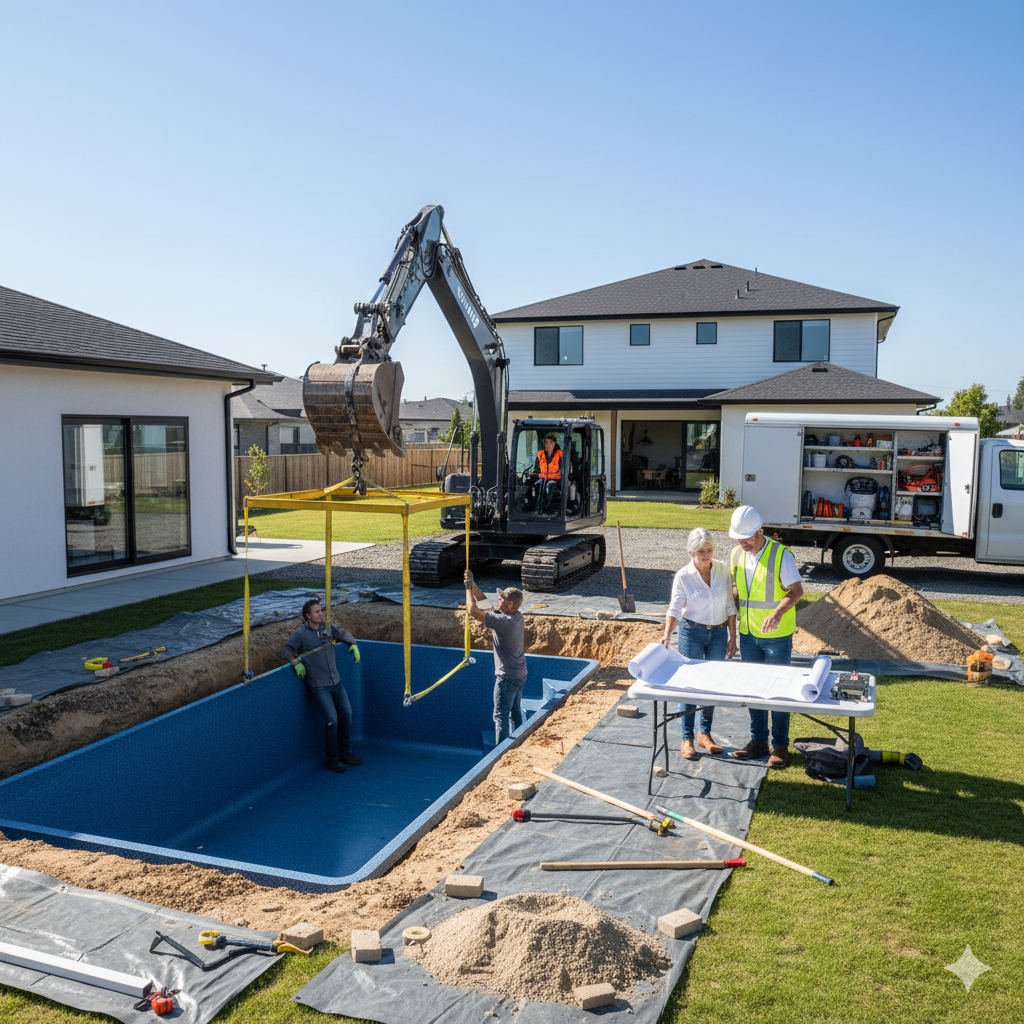
- Excavation (1–2 days): The “big dig,” where the shape of your oasis is carved out.
- Steel and Plumbing (1 week): Building the structural cage and the hydraulic network.
- Gunite Application (1 day): The shell is shot. This is followed by a “curing” period where the shell must be watered daily to achieve maximum strength.
- Tile and Coping (1 week): The decorative and functional edges are applied.
- Decking and Landscaping (1–2 weeks): Creating the surrounding environment.
- Plaster and Fill (2 days): The final interior finish is applied, and the pool is immediately filled with water to cure the finish under pressure.
8. Financial ROI: Equity and Resale in Grayson County
Is an In-Ground Pool Installation a sound financial move? In the growing Van Alstyne market, the answer is increasingly “yes.”
Market Demand
As more families relocate to North Texas from cooler climates, a pool has shifted from a “luxury” to a “requirement” for many buyers. Appraisals in the Southcreek or Steeplechase neighborhoods often show that a well-designed, professional pool can recoup a significant portion of its cost in immediate home equity.
The “Staycation” Value
Beyond the resale price, there is the “value of use.” A private pool eliminates the need for expensive club memberships and travel costs. It becomes the hub for birthdays, graduations, and quiet evening retreats, providing a lifestyle return on investment that is difficult to quantify but impossible to ignore.
9. Frequently Asked Questions (FAQ)
Q: Can I build an in-ground pool on a sloping lot in Van Alstyne? A: Absolutely. In fact, sloping lots allow for beautiful features like “infinity edges” or “raised beam” walls with sheer descent waterfalls. These projects require more complex engineering and retaining walls, but they result in some of the most stunning installations in the area.
Q: How do I maintain my pool during a North Texas freeze? A: Modern automation includes “freeze protection.” When temperatures drop below 34°F, the system automatically turns on the pumps to keep water moving. Moving water is much harder to freeze, protecting your plumbing and equipment from expansion damage.
Q: Is salt water better than chlorine? A: Most “salt pools” are actually chlorine pools. A salt cell uses electrolysis to turn salt into pure chlorine. It provides a much softer feel to the water and eliminates the “red-eye” effect of traditional chlorine tablets.
Conclusion: Building for the Future
An in-ground pool is one of the most significant changes you will ever make to your property. It is a commitment to quality of life and a statement of architectural taste. However, in the unique environment of Van Alstyne, TX, success depends on a partner who understands the local geology as well as the latest in hydraulic and sanitization technology.
At DSH Homes and Pools, we don’t just build pools—we build legacies. We invite you to explore the possibilities of your backyard and trust in a process that prioritizes structural integrity, energy efficiency, and timeless design.